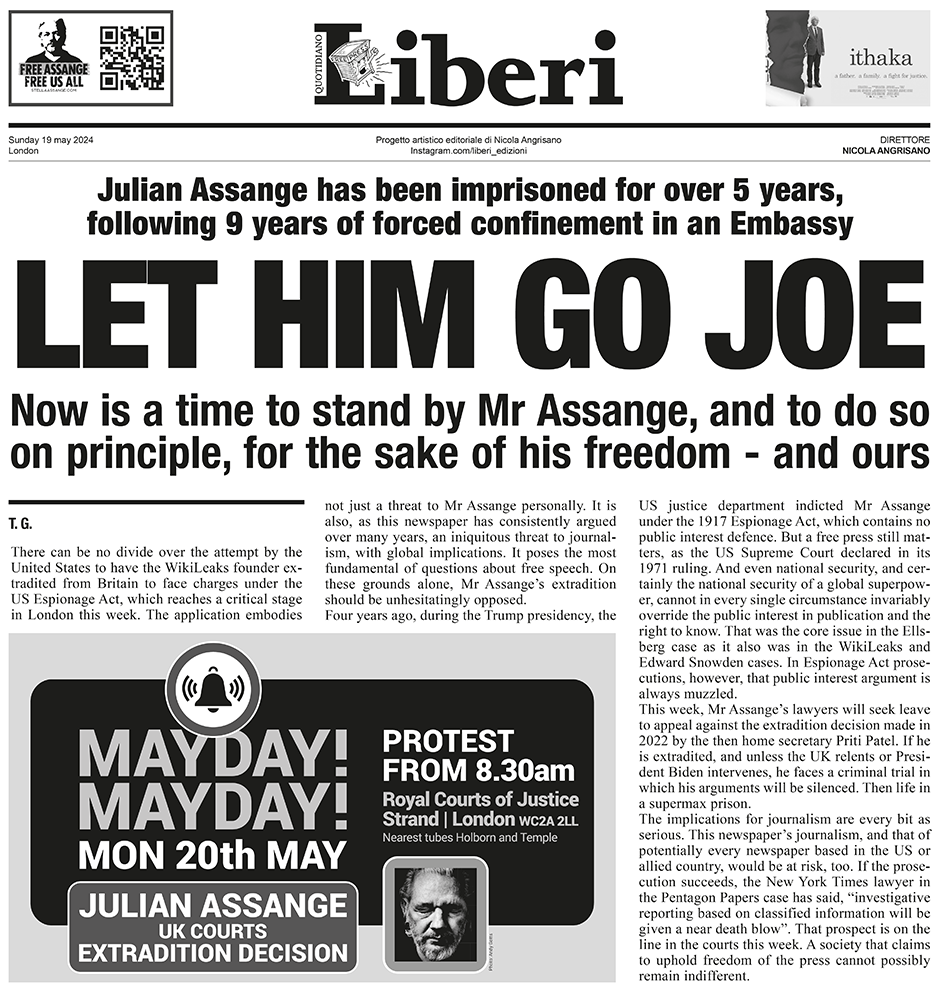
19/05/2024
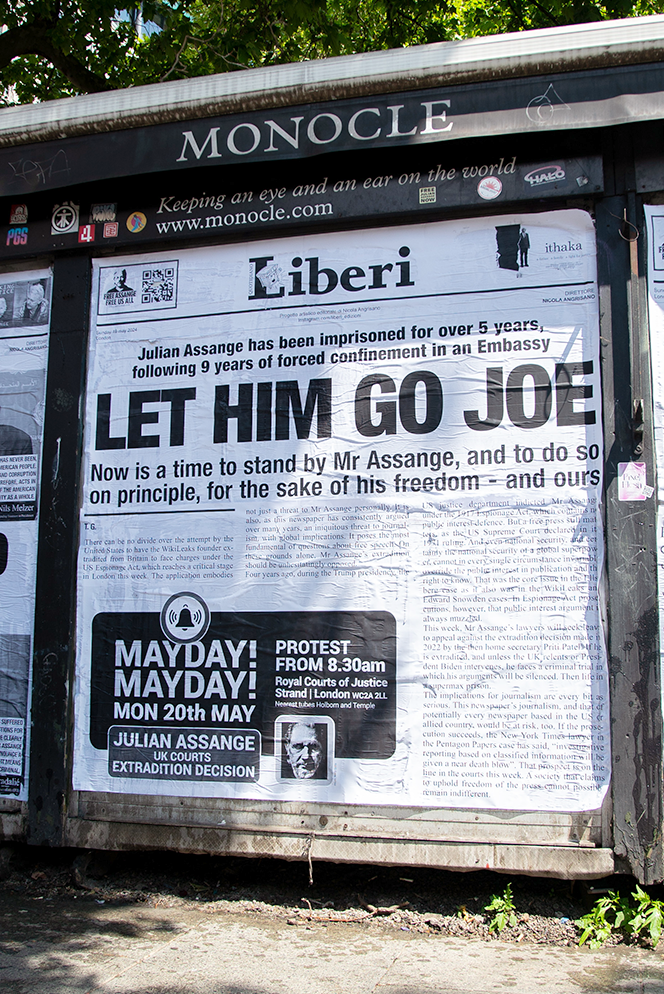
Julian Assange has been imprisoned for over 5 years, following 9 years of forced confinement in an Embassy
There can be no divide over the attempt by the United States to have the WikiLeaks founder ex- tradited from Britain to face charges under the US Espionage Act, which reaches a critical stage in London this week. The application embodies not just a threat to Mr Assange personally. It is also, as this newspaper has consistently argued over many years, an iniquitous threat to journal- ism, with global implications. It poses the most fundamental of questions about free speech. On these grounds alone, Mr Assange’s extradition should be unhesitatingly opposed.
Four years ago, during the Trump presidency, the US justice department indicted Mr Assange under the 1917 Espionage Act, which contains no public interest defence. But a free press still mat- ters, as the US Supreme Court declared in its 1971 ruling. And even national security, and cer- tainly the national security of a global superpow- er, cannot in every single circumstance invariably override the public interest in publication and the right to know. That was the core issue in the Ells- berg case as it also was in the WikiLeaks and Edward Snowden cases. In Espionage Act prose- cutions, however, that public interest argument is always muzzled.
This week, Mr Assange’s lawyers will seek leave to appeal against the extradition decision made in 2022 by the then home secretary Priti Patel. If he is extradited, and unless the UK relents or Presi- dent Biden intervenes, he faces a criminal trial in which his arguments will be silenced. Then life in a supermax prison.
The implications for journalism are every bit as serious. This newspaper’s journalism, and that of potentially every newspaper based in the US or allied country, would be at risk, too. If the prose- cution succeeds, the New York Times lawyer in the Pentagon Papers case has said, “investigative reporting based on classified information will be given a near death blow”. That prospect is on the line in the courts this week. A society that claims to uphold freedom of the press cannot possibly remain indifferent.